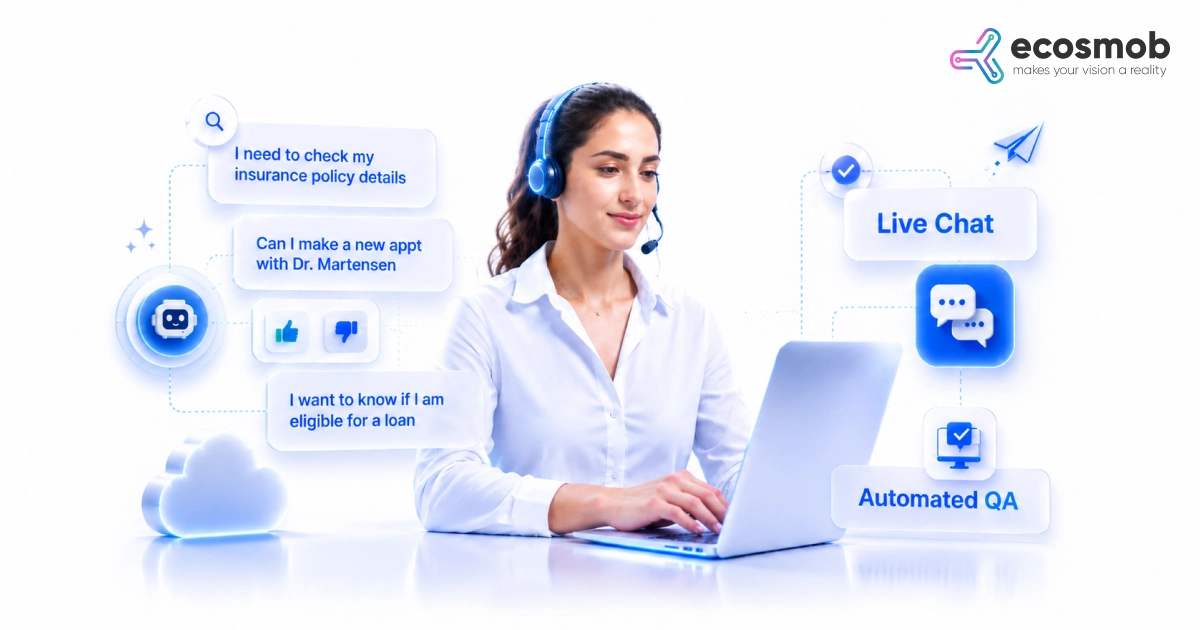
Real-time AI agent assist is becoming essential because you probably have that one agent everyone depends on in your contact center.
The person who knows every policy, remembers every workaround, and somehow always has the right answer. The problem starts when that agent goes on leave, resigns, or simply can’t help everyone at once.
Suddenly, your call times rise, supervisors get pulled into routine questions, and your customers start hearing, “Let me check that for you.”
You can add more training and create more documentation, but neither helps when your agents can’t find the right answer while a customer is waiting on the line.
What if every agent had access to the knowledge of your best employee exactly when they needed it?
That’s the promise of real-time AI agent assist, and in this guide, you’ll learn how it works, the impact AI can have on your contact center, and how you can integrate it into your existing systems.
What is Real-Time AI Agent Assist?
Deploying a Real-time AI agent assist helps your agents find the right answers while they are still talking to customers. It listens to the conversation, understands the issue, and suggests answers, next steps, or helpful resources in real time so your agents can resolve issues faster.
If your agents have ever put a customer on hold to search for information, asked a supervisor for help, or switched between multiple systems to find an answer, you’ve already seen the problem this technology is designed to solve.
Instead of expecting your agents to remember every policy, product detail, or troubleshooting step, real-time AI agent assist brings the right information directly into their workflow. It can surface knowledge articles, suggest responses, recommend next actions, and even generate call summaries automatically.
The result is simple: your agents spend less time searching and more time helping customers, leading to faster resolutions and more consistent experiences.
Again, the question arises: can a real-time AI agent replace human agents?
Real-time AI agent assist doesn’t replace your agents. It helps them perform with the confidence and knowledge of your most experienced team members.
So, how does all of this happen in real time?
How Does Real-Time AI Agent Assist Work?
Real-time AI agent assist works by combining speech recognition, AI, and knowledge retrieval to help your agents respond faster and make better decisions during customer interactions. As a custom AI assist for your business, it can also adapt to your workflows and support processes.
Most real-time AI agent assist solutions follow five steps.
Step 1: Capture the Conversation
The system listens to live calls and converts speech into text in real time. This allows it to understand what your customer is asking without waiting for the conversation to end.
Step 2: Understand the Customer’s Intent
AI analyzes the conversation to identify the customer’s issue, key topics, and even signs of frustration or urgency. For example, if a customer says, “I was charged twice,” the system can immediately recognize it as a billing issue.
Step 3: Find Relevant Information
The platform searches your knowledge base, CRM, and internal systems for information related to the customer’s query. This means your agents no longer have to switch between multiple screens or search through documents during a live conversation.
Step 4: Suggest the Next Best Action
Based on the context, the system can recommend responses, troubleshooting steps, or escalation paths. Instead of asking, “What should I do next?” your agents already have guidance in front of them.
Step 5: Automate After-Call Work
Once the interaction ends, the system can generate summaries, notes, and follow-up actions automatically. Your agents spend less time on administrative work and more time helping customers.
The process may sound sophisticated, but the outcome is straightforward: your agents get the right information at the right moment, and your customers get faster, more consistent support.
So, what does that mean for your contact center’s performance? Let’s look at the impact on efficiency next.
How Does Real-Time Agent Assist Improve Contact Center Efficiency?
Real-time AI agent assist improves contact center efficiency by giving your agents the right information during live interactions. This helps reduce call handling time, improve first-call resolution, lower after-call work, and shorten the time it takes for new agents to become productive. It can also work alongside a voicebot for intelligent customer support to deliver faster and more consistent customer experiences.
1. Reduce Average Handle Time (AHT)
Every time your agents search for information, the conversation slows down. Real-time AI agent assist brings answers directly into the workflow, helping your team resolve issues faster and handle more interactions without adding pressure.
2. Improve First Call Resolution (FCR)
Customers expect answers the first time they reach out. One of the most effective ways to improve FCR is by giving your agents real-time recommendations that help them resolve issues without follow-up calls.
3. Reduce After-Call Work
Notes and follow-up tasks can quietly consume a large part of an agent’s day. AI can automatically generate summaries and suggest next steps, giving your team more time to focus on customers instead of administration.
4. Accelerate Agent Training and Onboarding
New agents do not become experts overnight. Real-time guidance helps them handle conversations with greater confidence by providing information when they need it, reducing dependency on supervisors and speeding up onboarding.
The outcome is simple: your agents spend less time searching and more time helping customers.
So, what capabilities should you look for if you’re evaluating a real-time AI agent assist solution?
Key Features to Look for in Real-Time Agent Assist Software
 The best real-time agent assist software does more than transcribe conversations. It helps your agents find answers faster, make better decisions, and deliver more consistent customer experiences. If you’re evaluating solutions, there are a few capabilities that can make a meaningful difference.
- Real-Time Transcription
The platform should convert conversations into text as they happen. This creates the foundation for everything else, allowing the system to understand customer needs and provide assistance without waiting for the call to end.
- AI-Powered Knowledge Suggestions
Your agents should not have to search through multiple systems during a live conversation. A strong solution automatically surfaces relevant articles, policies, and troubleshooting steps when they are needed.
- Next Best Action Recommendations
Knowing the next step can make the difference between a resolved issue and a frustrated customer. Look for platforms that can recommend responses, escalation paths, or follow-up actions based on the context of the conversation.
- Automatic Call Summaries
After-call work often takes longer than most teams realize. Automatic summaries help your agents spend less time on administrative tasks and more time helping customers.
- CRM Integration
Customer information is only useful if your agents can access it quickly. That’s why voice agent and CRM integration is important, allowing agents to view customer history and update records without switching between applications.
- Supervisor Insights and Coaching
Not every issue requires a supervisor to step in. Real-time insights help managers identify where agents need support and provide targeted coaching instead of reacting after problems occur.
- Multilingual Support
If your customers speak different languages, your agent assist platform and Multilingual IVR should be able to keep up. Multilingual capabilities help your team deliver more consistent experiences across regions and customer segments.
No platform will offer the same combination of capabilities. The key is choosing features that solve the problems your agents deal with every day. Though even the best features have limited value if they cannot work with the systems you already use.
What if I told you that real-time agent assist can integrate with your existing CRM?
Can You Integrate Real-Time Agent Assist With Your Existing CRM Software?
Yes. Most real-time AI agent assist solutions can integrate with your existing CRM software, giving your agents customer information and recommendations without switching between multiple systems.
If your agents constantly move between the CRM, knowledge base, and support tools during a live conversation, you already know why integration matters.
When your CRM and agent assist platform work together, your agents can:
- View customer history in one place.
- Receive context-aware recommendations.
- Reduce manual updates and note-taking.
- Deliver faster, more personalized support.
The goal isn’t to replace your existing systems. It’s to make the information inside them easier to access when your agents need it most.
Most modern solutions can integrate with popular CRM platforms and support communication environments that require FreeSWITCH AI integration and real-time assistance capabilities.
Once your systems start working together, real-time AI agent assist becomes far more effective.
But where does this technology fit within your existing contact center infrastructure? Let’s look at the architecture next.
What Does a Real-Time AI Agent Assist Architecture Look Like?
A typical real-time AI agent assist architecture sits between your communication platform and business applications. It listens to live conversations, analyzes customer intent, retrieves information from your systems, and delivers recommendations directly to your agents.
These same architectural principles also apply when building a production-ready voicebot.

Here’s what happens behind the scenes.
A customer starts a conversation through your contact center platform, such as Asterisk or FreeSWITCH. The audio stream is then converted into text so the AI can understand what the customer is asking.
The AI engine analyzes the conversation in real time and retrieves relevant information from your CRM, knowledge base, or internal systems. It then surfaces recommendations, suggested responses, or next steps directly on the agent’s screen.
The goal isn’t to replace your existing infrastructure. It’s to make the information across your systems work together in real time.
This architecture allows your agents to spend less time searching for answers and more time helping customers. It also gives you the flexibility to introduce AI capabilities without rebuilding your entire contact center stack.
And once you understand how the technology fits into your environment, the next question becomes simpler: where can real-time AI agent assist deliver the biggest impact?
Common Use Cases of Real-Time AI Agent Assist in Contact Centers
Real-time AI agent assist is one of the real-world applications of conversational AI, especially in industries where agents handle complex information, frequent policy changes, or high volumes of customer interactions. It helps your teams deliver faster and more accurate responses without relying entirely on experience or memory.
- Healthcare
Healthcare agents often need to verify appointments, insurance details, and patient information while following strict compliance requirements. Real-time guidance helps your team access the right information quickly and reduces the risk of errors during patient interactions.
- Banking and Financial Services
Financial institutions deal with changing regulations, complex products, and sensitive customer requests. Real-time AI agent assist can surface compliance prompts, recommended actions, and relevant customer information, helping your agents resolve issues with greater confidence.
- Insurance
Policy details, claims processes, and coverage rules can vary significantly between customers. Instead of placing customers on hold to search for information, your agents can receive recommendations and next steps during the conversation itself.
- E-Commerce and Retail
Customer inquiries often increase during seasonal sales, product launches, and promotional campaigns. Real-time guidance helps new and experienced agents answer questions consistently, even during periods of high call volume.
- Telecommunications and Technology Support
Technical support teams frequently handle troubleshooting scenarios that require multiple steps. AI can surface knowledge articles and troubleshooting workflows in real time, helping your agents reduce resolution times and improve the customer experience.
The use case may differ from one industry to another, but the challenge is often the same: your agents need the right information at the right moment.
The use cases may differ, but the goal remains the same: give your agents the right information at the right moment so they can deliver better customer experiences with less effort.
The Bottom Line?
Real-time AI agent assist isn’t about replacing your agents. It’s about helping them respond faster, make better decisions, and deliver more consistent customer experiences.
As customer expectations continue to rise, giving your agents real-time guidance is quickly becoming a competitive advantage rather than a nice-to-have capability.
If you’re exploring how to bring real-time AI assistance into your contact center, the right technology and integration approach can make all the difference.
That’s where Ecosmob’s expertise in AI-powered contact center and communication solutions can help you build a solution that fits your existing environment and business goals.
Frequently Asked Questions
Real-time AI agent assist supports human agents during live customer interactions by providing recommendations, knowledge, and next steps. AI chatbots, on the other hand, interact directly with customers and handle conversations without human intervention.
Real-time AI agent assist reduces agent stress by surfacing relevant information during conversations. Agents spend less time searching for answers, handling repetitive tasks, or relying on supervisors, allowing them to focus on resolving customer issues more confidently.
Yes. Real-time guidance helps new agents handle customer interactions without memorizing every policy or process beforehand. This shortens ramp-up time and enables new hires to become productive faster.
Key features include real-time transcription, AI-powered knowledge suggestions, next-best-action recommendations, automatic call summaries, CRM integration, supervisor insights, and multilingual support.
Most modern solutions can integrate with existing communication systems, CRMs, and knowledge bases. They can also work alongside platforms such as Asterisk and FreeSWITCH without requiring a complete infrastructure replacement.